
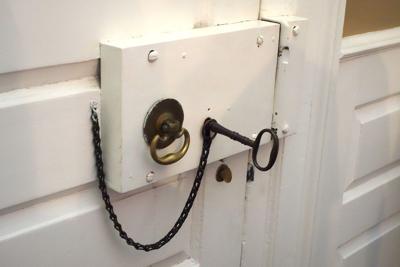

A rim lock on a panelled door. However good the lock, what holds under a kick is the strike plate and the frame behind it.
Photo: Longfellow National Historic Site, National Park Service. Public domain, via Wikimedia Commons.
Short answer: almost no forced entry defeats the lock. It defeats the frame, the strike, the hinges or the glass beside the door. A serious lock on a softwood jamb with three-quarter inch screws is an expensive object attached to a weak point.
Homeowners buy locks. Burglars break frames. That mismatch explains why so many houses with impressive hardware get opened in seconds, and why a modest lock on a properly prepared opening is genuinely difficult to defeat.
The door is a system: leaf, frame, strike, hinges, cylinder and the glass around it. It fails at whichever part received the least thought, and that is almost never the lock body.
The strike and the frame carry the load
When a door is kicked in, the bolt usually survives. What gives way is the strike plate, tearing out of the door casing along with the screws holding it.
Most strikes are fixed with short screws into the casing trim, which is itself nailed to the framing. The bolt may be hardened steel, but it is landing in a piece of decorative timber.
Three changes fix the majority of it:
- Long screws. Replace the strike screws with 3-inch screws that reach the structural stud behind the jamb.
- A box strike, which captures the bolt on four sides rather than letting it sit in a stamped opening.
- A reinforced jamb on a door with a history of trouble, or on a rear entrance out of public view.
The parts cost less than a takeaway. It is the single highest-return change available on any front door.
Hinges are the other half of the opening
Every argument about locks concerns one edge of the door. The other edge is held by three hinges, and on an outswing door the pins are on the outside.
Fixes are straightforward: non-removable pins, or hinge studs that engage a matching hole in the jamb so the leaf cannot be lifted off even with the pins out. On a heavy leaf, check the hinge rating too, because a door that has dropped no longer closes into its strike properly and the deadbolt stops throwing fully home.
That last point is worth repeating. A deadbolt that only engages halfway because the door has settled is not a deadbolt, it is a latch with extra steps. It is also the most common security fault in older homes, and it is invisible until someone tests it.
Where the lock does matter: the cylinder and the bolt
Once the frame and hinges are sound, the lock becomes the weak point, and two attacks matter: picking and snapping.
A cylinder with anti-pick and anti-drill pins raises the effort considerably. Anti-snap protection matters on euro-profile cylinders in particular, where a cheap cylinder can be snapped by hand in seconds.
For an entrance in constant use, a mortise lock remains the durable choice. The mechanism sits in a pocket cut into the door rather than bolting through it, which gives it a heavier action and a far longer service life. That robustness has a price: in an analysis of 15,447 door hardware SKUs, mortise locks carried a median price of $834, against $328 for the cylindrical equivalent.
Whether that gap is worth it depends entirely on traffic. On a front door opened forty times a day, the mortise outlives several cylindrical locks. On a guest bedroom, it is money spent on nothing.
The sidelight problem
A door can be perfect and irrelevant if there is a pane of glass within arm’s reach of the thumb turn.
This is the flaw designers create most often, because sidelights and glazed panels are exactly what makes an entrance feel generous. The glass gets broken, a hand reaches through, and the interior thumb turn is simply turned.
The options, in order of how well they preserve the design:
- Laminated or security glazing in any pane within 40 inches of the lock. It looks identical and resists a hand going through it.
- A double-cylinder deadbolt, keyed both sides, which removes the thumb turn. Check local fire codes first, because in many jurisdictions this is restricted on egress doors for good reason.
- Moving the glazing out of reach of the lock at design stage, which is free if it happens early enough.
What upgrading actually costs
Ranked by return per dollar on a typical entrance:
Change | Relative cost | Effect |
|---|---|---|
3-inch strike screws and box strike | Negligible | Removes the most common failure |
Non-removable hinge pins | Negligible | Closes the hinge-side attack |
Anti-snap, anti-drill cylinder | Low | Defeats the quickest lock attacks |
Laminated glazing in sidelights | Moderate | Closes the reach-through |
Mortise lock upgrade | Highest | Durability on a high-traffic door |
The pattern is consistent: the cheapest changes close the biggest holes. The expensive upgrade is about how long the door lasts, not how hard it is to open.
Frequently asked questions
What is the weakest part of a front door? The strike plate and the frame it is fixed to. Most forced entries tear the strike out of the door casing rather than breaking the lock or the bolt.
Do longer screws really make a difference? Yes. Standard strike screws bite into casing trim; 3-inch screws reach the structural stud behind the jamb, so a kick has to break framing rather than trim.
Is a mortise lock worth the extra cost? On a high-traffic entrance, yes. The mechanism sits in a pocket in the door and outlasts several cylindrical locks. In a catalogue analysis of 15,447 SKUs the median mortise lock was $834 against $328 for a cylindrical equivalent, so it is a durability decision rather than a security one.
How do I secure a door with glass next to it? Use laminated or security glazing in any pane within arm’s reach of the lock. A double-cylinder deadbolt also works but is restricted on egress doors in many jurisdictions, so check local fire code first.
Figures cited are drawn from an analysis of 15,447 live door hardware SKUs, priced on a sample of 2,084, conducted in 2026.
Related articles from FINE Magazine:
- Simple Garage Door Upgrades That Boost Daily Comfort
- How to Take Care of the Exterior of Your Home
- Keyless Entry for Homes: The Smart Front Door Upgrade That Makes Everyday Living Easier
(0) comments
We welcome your comments
Log In
Post a comment as Guest
Keep it Clean. Please avoid obscene, vulgar, lewd, racist or sexually-oriented language.
PLEASE TURN OFF YOUR CAPS LOCK.
Don't Threaten. Threats of harming another person will not be tolerated.
Be Truthful. Don't knowingly lie about anyone or anything.
Be Nice. No racism, sexism or any sort of -ism that is degrading to another person.
Be Proactive. Use the 'Report' link on each comment to let us know of abusive posts.
Share with Us. We'd love to hear eyewitness accounts, the history behind an article.