
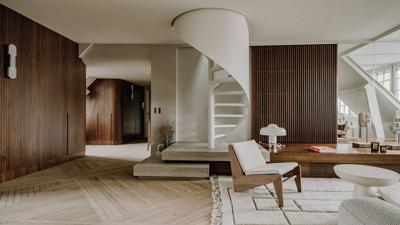

A well-designed room is usually described in terms of what you can see and occasionally what you can touch. The finish on the joinery, the weight of the drapery, the way light moves across a plaster wall at four in the afternoon. Almost no design brief addresses what the room smells like, which is strange, because it is the first thing a visitor registers and the last thing they remember. Scent operates below the level of conscious attention, and that is exactly what makes it powerful.
1. A House Announces Itself Before You See It
Walk into any building and your nose reports back before your eyes have finished adjusting. Old timber, cold stone, fresh paint, a kitchen that was used an hour ago. Estate agents have understood this for decades, which is why the advice about baking bread before a viewing has survived every change in the market. The lesson for anyone living in a house rather than selling one is that this layer already exists whether you have thought about it or not. You are not adding scent to a neutral room; you are editing something that is already there.
2. Start With Subtraction
The most common mistake is treating fragrance as an additive problem. Before adding anything, find and remove what is competing. Damp in a basement, a laundry cycle that never fully dries, a kitchen extractor that has not been serviced, upholstery that has absorbed years of cooking. Layering a candle over any of those produces something worse than either on its own. Ventilation first, remediation second, fragrance a distant third. This is unglamorous, and it is the step that separates a house that smells considered from one that smells like it is hiding something.
3. The Materials Are Already Doing This
Natural materials carry their own register and they are more assertive than most people expect. Cedar-lined storage, waxed oak, wool rugs, leather seating, unsealed stone and lime plaster all contribute continuously, without any intervention and without cost. Rooms that feel effortlessly atmospheric usually have several of these working together. Synthetic surfaces contribute nothing, which is why a technically flawless interior in engineered materials can feel oddly blank in a way nobody can quite name.
4. Not Every Room Wants the Same Register
Treating the whole house as a single environment is a mistake, and a diffuser on every floor is how you get scent fatigue by Tuesday. Think in zones. An entrance can carry something structured and slightly formal, since nobody stands in it for long. Living areas want something quiet enough to sit inside for three hours. Kitchens are usually better left to their own devices. Bedrooms should be nearly neutral, because a room you sleep in is a room you have stopped being able to smell anyway, and anything strong enough to notice is too strong to sleep in.
5. Where Personal and Interior Scent Meet
The dressing table is the point of overlap, and it is worth treating as a designed surface rather than a storage problem. Perfume bottles are objects with real presence, and some houses design them that way deliberately: clive christian fragrances are presented in decanter-style flacons with faceted glass and metal collars, drawing on the Crown Perfumery lineage the house acquired in the 1990s, and they read as decorative objects in a way that a modern minimalist bottle does not. Displayed well, on a tray, on a surface away from direct light, a small group of them does the job a sculpture would. The practical caveat is that display and preservation pull in opposite directions, so keep the group out of the sun and accept that anything on permanent show is a bottle you should be using rather than saving.
6. Scent Changes With the Season, and So Should the Room
The single most effective habit is also the simplest: change what you are using twice a year. Warm, resinous, sweet compositions suit rooms in winter, when windows stay closed and heating flattens everything; the same materials in July feel heavy and slightly stale. This applies to what you wear indoors as much as to what you burn. Something like parfums de marly althair, built on vanilla and almond warmth, belongs to the months when a room is lit at four in the afternoon, and it will feel like a mistake in a house full of open doors in June. Green, citrus and herbal registers take over for the warm half of the year. Two changes annually is enough; anything more becomes a hobby.
7. Common Mistakes, and a Few Questions
The recurring errors are worth naming. Too many sources running at once, which produces a muddle nobody can identify. Scent used to cover rather than complement. And placement that ignores airflow, since a diffuser next to a return vent is scenting your ductwork rather than your drawing room. How much is too much? If you can smell it after ten minutes in the room, it is too strong for anyone who lives there, because your own nose adapts within minutes and a guest's does not. Do candles and diffusers behave differently? Yes. A burning candle projects actively and stops when extinguished, while a reed diffuser works passively and continuously, which makes it the better choice for a hallway and the worse one for a small study. And is any of this worth doing in a house on the market? More than most staging. It is the one element a buyer will register and be unable to attribute.
(0) comments
We welcome your comments
Log In
Post a comment as Guest
Keep it Clean. Please avoid obscene, vulgar, lewd, racist or sexually-oriented language.
PLEASE TURN OFF YOUR CAPS LOCK.
Don't Threaten. Threats of harming another person will not be tolerated.
Be Truthful. Don't knowingly lie about anyone or anything.
Be Nice. No racism, sexism or any sort of -ism that is degrading to another person.
Be Proactive. Use the 'Report' link on each comment to let us know of abusive posts.
Share with Us. We'd love to hear eyewitness accounts, the history behind an article.