
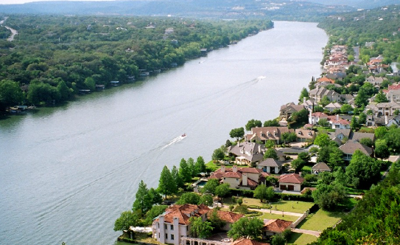

Texas' Highland Lakes stretch across Central Texas like liquid jewels, but their sparkling surfaces hide stories most visitors never hear. These lakes didn't just appear one day; they emerged from failures, floods, and communities willing to sacrifice everything for progress. The six connected lakes between Austin and Burnet transformed an entire region in just 15 years, reshaping the landscape and the lives of everyone who lived here.
For those considering a move to these historic waters, understanding the area's heritage matters as much as finding the right property. For example, Fokus Waterfront specializes in guiding buyers through both: combining 15+ years of market expertise with deep local knowledge to help you discover properties that match your vision for Highland Lakes living. Whether you're drawn to waterfront homes, hilltop retreats, or established lake communities, their team understands not just the real estate but the stories that make these neighborhoods distinctive.
Here are six surprising facts that explain why Highland Lakes communities feel different from anywhere else in Texas.
How Austin's Dream Lake Vanished Overnight
In 1893, Austin's mayor, John McDonald, watched other cities race ahead with electric power and decided his town needed to catch up fast. His plan was bold: dam the Colorado River, create a massive lake for hydroelectric power, and put Austin on the industrial map. They called it Lake McDonald.
The dam stood 60 feet tall and stretched 1,200 feet across the Colorado. For a few years, it worked. Austin got electricity, and civic leaders celebrated their foresight. Then came April 1900.
Spring storms dumped record rainfall across Central Texas. The Colorado River swelled into a raging wall of water that hit the granite dam like a sledgehammer. Within hours, the entire structure collapsed. Lake McDonald vanished overnight, rushing downstream in a torrent that left nothing but rubble and regret.
People called it "The Great Granite Dam Failure," and it haunted Austin for decades. The city wouldn't attempt another dam for 42 years. But the disaster taught engineers exactly what not to do, lessons that later shaped the Highland Lakes success story. Today, an Austin Dam Memorial marks where ambition met the Colorado River and lost.
Why a Town Named 'Marble Falls' Has No Falls
If you visit Marble Falls today, you'll notice something odd. The town has no waterfalls. Zero. Not even a trickle over rocks. So why the name?
Step back to 1854. A Civil War veteran named Adam Johnson arrived in Central Texas completely blind. Despite losing his sight in the 1864battle, Johnson had heard travelers describe thundering waterfalls on the Colorado River so vivid they stayed in his mind. He never saw the falls himself but loved their sound and the stories people told.
Johnson founded a settlement right there. Early settlers mistook the local limestone for marble (it wasn't), and the name stuck twice over.
Then came the 1950s dam-building boom. Max Starcke Dam rose nearby, backing up water that swallowed the falls completely. They sit 20 feet underwater now. The lake would need to drop seven feet before anyone could see them again.
The town adapted. Marble Falls today draws visitors for wine tours, granite heritage sites, and lakeside living rather than for its waterfalls. The "blind man's town" became a lake community, trading one natural wonder for another.
When Drought Revealed a 75-Year-Old Ghost Town
Before 1939, Bluffton was a real community. Fifty families lived there. Kids went to school there. Cotton gins processed harvests, and pecan orchards lined the streets. Then the Buchanan Dam started, and everyone had to leave.
The government needed the valley for Lake Buchanan. Residents packed what they could carry and watched water swallow their homes, churches, cemetery, and hotel. For 70 years, Bluffton stayed submerged, a memory that faded with each generation.
Then, in the late 2000s, extreme drought struck. Lake levels dropped month after month. In 2011, foundations began appearing. Gravestones poked through the mud. Stone walls emerged. The old Bluffton cemetery rose from the lake bed like something from a ghost story.
The Texas Historical Commission moved fast. Archaeologists documented everything before the water returned. They photographed home sites, measured building foundations, and recorded grave markers. Some families whose ancestors were buried there finally found closure.
Today, you can book history cruises that pass over Bluffton's watery grave. Guides point to the depths and tell stories of the "lost civilization" underneath. The town represents what Highland Lakes communities gave up for the dam system, progress bought at the price of history.
Progressive Leadership Came to Highland Lakes Early
Here's a fact that surprises people: Highland Lakes communities elected a female mayor before women could even vote nationwide.
The 19th Amendment was passed in 1920, but some Texas lake towns had already elected women to leadership positions. These weren't traditional farming communities. They were new settlements built around water management projects, attracting independent thinkers who valued competence over convention.
That forward-thinking spirit stuck. Highland Lakes communities still have a reputation for progressive local leadership and residents who tackle problems with pragmatic creativity. The lakes drew people willing to reimagine how communities could work.
Lake LBJ: When a President Made a Texas Lake His Personal Retreat
You probably know Lake LBJ exists, but do you know it was called something else first?
Engineers finished the dam in 1950 and named the reservoir Lake Granite Shoals. Pretty straightforward. Then Lyndon B. Johnson bought a working ranch right on the shore. He used it during his time as vice president and later as president, hosting everything from family barbecues to international diplomacy.
In 1965, the lake was renamed Lake Lyndon B. Johnson in his honor. LBJ championed the Highland Lakes system throughout his career and saw it as proof that government could solve problems ordinary citizens couldn't tackle alone.
The lake stretches 21 miles long, covers 6,500 acres, and reaches 90 feet deep in spots. Here's what makes it special: Lake LBJ maintains a near-constant water level year-round. Unlike other Texas reservoirs that rise and fall with rainfall, Lake LBJ stays steady for boating and waterfront living.
LBJ Ranch is now a National Historical Park. Thousands tour it yearly, learning about the president who shaped the region's future. His legacy still influences lake communities like Horseshoe Bay, Sunrise Beach, and Kingsland.
How Texas Conquered Centuries of Water Chaos in 15 Years
Before dams, Central Texas water was chaotic. Devastating droughts lasted for years. Flash floods destroyed entire settlements overnight. Farmers couldn't count on crops. Towns couldn't plan growth. The pattern repeated for 300 years.
The Texas Legislature created the Lower Colorado River Authority in 1934 specifically to fix this. LCRA's job was simple to describe but brutal to execute: control the Colorado River in its entirety.
Between 1938 and 1952, crews built six dams in sequence. Buchanan Dam came first in 1938, followed by Inks that same year. Tom Miller Dam rose in 1940, Mansfield in 1942, Max Starcke in 1949, and Wirtz Dam closed the chain in 1952.
The results changed Central Texas forever. The 6-dam chain created the largest connected lake system in Texas. Today, it provides water to more than one million people, generates hydroelectric power, controls floods, and supports lake communities across five counties.
The system survived its biggest test during the 2008-2016 megadrought. Lakes dropped to historic lows, but careful management and water modeling kept taps running. LCRA still manages the Highland Lakes today, balancing recreation, conservation, and growth.
Why These Stories Matter Now
Highland Lakes' history isn't just interesting trivia. It explains why these communities feel different. They emerged from engineering ambition, forced relocations, and the kind of can-do spirit that builds six dams in 15 years.
When you buy property here, you're joining communities built on transformation. The same waters that swallowed Bluffton also created Horseshoe Bay. The failed Austin dam taught lessons that made Lake Travis possible. A blind veteran's vision became Marble Falls.

(0) comments
We welcome your comments
Log In
Post a comment as Guest
Keep it Clean. Please avoid obscene, vulgar, lewd, racist or sexually-oriented language.
PLEASE TURN OFF YOUR CAPS LOCK.
Don't Threaten. Threats of harming another person will not be tolerated.
Be Truthful. Don't knowingly lie about anyone or anything.
Be Nice. No racism, sexism or any sort of -ism that is degrading to another person.
Be Proactive. Use the 'Report' link on each comment to let us know of abusive posts.
Share with Us. We'd love to hear eyewitness accounts, the history behind an article.