
Article update 6/2/2015: The Brain Observatory is no longer affiliated with UCSD; but it is now operating as an independent research unit supported by The Institute for Brain and Society.
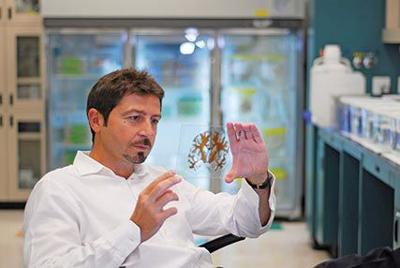
Dr. Jacopo Annese, neuroscientist and director of The Brain Observatory in San Diego, is building this library—a database that will house detailed information and images from hundreds of donors. Annese makes all this data available to anyone who has a burning desire to learn more about this fascinating organ.
Dr. Jacopo Annese is acquiring scans from participants using Magnetic Resonance Imaging (MRI) but his team also create much more detailed maps from actual brains that are donated to the project. Thanks to large-format microscope scanners that were designed at The Brain Observatory, brain slices are archived at a resolution of less than one-half of a micron per pixel. These images are of such high quality that researchers can zoom in on a single cell; crucially, these images can be viewed on the web using Google maps!
But the work doesn’t end there. Dr. Annese is also documenting each donor’s personal interest, culture, diet, habits and lifestyle. While many researchers are only interested in the brain itself, personality and lifestyle may play a big role in mental health and the progression of neurological disease. In the future, leveraging detailed donor profiles, scientists can detect brain patterns that might have been overlooked in a typical doctor’s office. By documenting these patterns many diseases could be detected sooner and managed more successfully.
This information can be accessed by any doctor who may need a more detailed look into the brain. Not only health professionals, but also researchers, students and educators will be able to easily access this information by typing specific criteria such as sex, age or occupation. Then the doctors would have detailed images, along with a comprehensive profile of medical and personal information, to compare against their patient. This will help doctors predict diseases before they happen or pinpoint the exact cause.
By using this library, doctors would be able to provide patients with more personalized treatment. No other institute in the world currently offers these capabilities. This digital brain library is one of the world’s most innovative brain banks. Along with the 1,000 brain project—the goal of digitizing 1,000 brains at the cellular level — Dr. Jacopo Annese said he hopes the library will one day help to answer questions about major neurological diseases, such as Alzheimer’s and Parkinson’s. Part of Annese’s vision is also developing The Brain Observatory as a space for exhibits on the brain where the public can visit and learn in an interactive, inspiring environment.
With these innovative tools, students, researchers, doctors and even the general public will have the opportunity to study the amazing bundle of cells that makes us who we are. Dr. Jacopo Annese and his team are working diligently to study patients as thoroughly as possible.

(0) comments
We welcome your comments
Log In
Post a comment as Guest
Keep it Clean. Please avoid obscene, vulgar, lewd, racist or sexually-oriented language.
PLEASE TURN OFF YOUR CAPS LOCK.
Don't Threaten. Threats of harming another person will not be tolerated.
Be Truthful. Don't knowingly lie about anyone or anything.
Be Nice. No racism, sexism or any sort of -ism that is degrading to another person.
Be Proactive. Use the 'Report' link on each comment to let us know of abusive posts.
Share with Us. We'd love to hear eyewitness accounts, the history behind an article.