
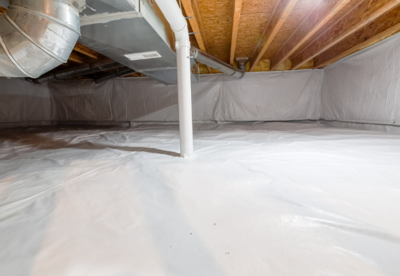

Most people don't go looking for crawl space mold. They find it by accident. A plumber's down there fixing a line, or a home inspector swings a flashlight into the wrong corner during a sale, and suddenly there's a much bigger conversation happening than anyone signed up for. Ten o'clock at night, standing in the garage googling foundation repair virginia beach va, half convinced the whole house is compromised, half hoping it's nothing. Most homeowners have been there once, at least.
It's rarely nothing, though it's also rarely as bad as it feels in the moment. Mold under a house is common across Hampton Roads, mostly because the humidity and water table here practically hand it the conditions it needs. The part that matters is catching it while it's still a moisture problem, before it turns into something structural.
How Crawl Space Mold Connects To Foundation Problems
Mold on its own doesn't bring a house down. What it does is feed on the wood underneath it, and given enough time, that wood softens, loses strength, and eventually stops holding up the floor the way it's supposed to. That overlap between a moisture issue and an actual foundation concern is exactly why a lot of local companies offer a free crawl space inspection before anyone commits to a bigger repair. Catching mold while it's still sitting on the surface is a completely different job than catching it once the joists underneath have already started to give.
Older homes across Norfolk, Chesapeake, and Virginia Beach run into this constantly. A lot of them were built with vented crawl spaces, which sounds like it should help with airflow but really just invites humid outside air year round, giving mold spores exactly the damp, still environment they need to settle and spread.
Why Hampton Roads Crawl Spaces Grow Mold So Easily
Mold needs three things going for it: moisture, something to feed on, and air that isn't moving. A typical crawl space checks every one of those boxes without trying. Wood framing and subfloor insulation give it plenty to eat, and the enclosed, poorly ventilated space traps humidity instead of letting it go anywhere.
The region itself doesn't help. Coastal Virginia sits low, with a water table that stays close to the surface most of the year, and homes near marshland or tidal creeks deal with groundwater seeping in even on days it hasn't rained. Throw in a humid stretch that runs from April into October most years, and a crawl space here has a lot more chances to grow mold than one sitting in a drier inland state ever would.
Recognizing Mold Before It Becomes Obvious
- A musty, earthy smell in the rooms above the crawl space, often there well before anything looks visibly wrong
- Dark spots or a fuzzy texture on wood framing, insulation, or ductwork, visible with nothing more than a flashlight
- Humidity readings that run high inside the crawl space itself, if anyone's ever placed a hygrometer down there
- Warped or soft flooring in the rooms sitting directly above known damp spots
- Allergy symptoms in the household that seem to ease up whenever everyone's away from the house for a few days
Black Mold And The Other Types Homeowners Run Into
The black mold is also called Stachybotrys, which is typically dark green to nearly black with the slimy appearance, and it possesses the greatest health risk, normally associated with excess moisture or even flooding.
As forAspergillus, it occurs frequently and has the color green, yellow or white, and is not as much related to excess moisture as to constant humidity, which never really dries.
Cladosporium completes the list, olive green to brown in color, and normally poses the least health risk but still indicates long-term presence of dampness on the wood or insulation.
In particular, homeowners concentrate on the black mold, and although it presents the greatest health danger, the very presence of any type of mold under the house suggests that the issue with excess moisture needs to be addressed.
What Happens During A Free Crawl Space Inspection
The inspection process begins with a walk-through, looking out for any presence of standing water, mold, sagging insulation, and wood showing signs of discoloration and softness. Humidity is also checked since a reading above sixty percent alone is enough to trigger mold formation even without the presence of standing water.
Further, the source of moisture is located by the technician, which could be an open foundation vent with humidity entering the building, poor grading leading to the flow of rain water towards the building, and even ground water flowing upwards through an unsealed dirt floor. It is the identification of the source of moisture that is more important than finding the mold itself since getting rid of the mold without treating the cause will only buy you some silent months.
Fixing The Mold Versus Fixing What Caused It
Plenty of homeowners try handling visible mold on their own first, a bleach solution, a store bought mold spray. It can knock down surface mold on non porous materials well enough, but it does very little for mold that's already worked into wood grain, and nothing at all for the humidity or standing water that let the mold grow there in the first place.
However, effective remediation involves not just cleaning, but also removing all items that cannot be saved and treating what is left and then addressing the moisture itself using methods like encapsulation, additional drainage or blocking the vents which allows moist outdoor air to enter non-stop. Fail to do this latter part, and it is understandable why the very same mold will grow again eighteen months from now no matter how diligently the initial clean was done.
When It's Worth Getting A Professional Opinion
Visible mold growth, persistent mustiness or odd sensations when walking across the floor should definitely serve as reasons enough to ask for evaluation instead of waiting to see what will happen. Properties which have not been evaluated for mold presence in their crawl space over the last twelve months, and particularly old buildings in the Hampton Roads region, should also consider getting an evaluation regardless of current situation.
Frequently Asked Questions
Is all mold in a crawl space harmful to the health of a family?
No, not all mold poses a danger; however, the mold that forms in an indoor environment is capable of causing allergic reactions in certain individuals. It is especially important to take measures when the black mold appears.
Will the crawl space mold spread through the house?
Yes, mold spores move upwards via floor joists and openings between plumbing or ducting, which is normally the reason for the musty smell in the upper parts of the house before seeing the mold itself.
What is usually included in the cost of mold remediation services?
It involves the removal of the affected building materials, treatment of those surfaces where the mold appeared, and correction of the source of the moisture (for instance, poor drainage, ventilation opening, or high water level).
Does encapsulation prevent mold from coming back?
In most cases, yes. A proper encapsulation seals the crawl space off from outside humidity and groundwater almost entirely, and it's one of the more reliable long term fixes once the original mold's been dealt with.
How often should a crawl space get checked for mold?
Once a year is a reasonable baseline, though homes with a history of flooding or high humidity might do better checking every few months instead.
Mold found in the crawl space doesn’t announce its presence like a broken pipe would do. It develops gradually without making any noise until the smell or weak spots on the floor tip off to it. Conducting an immediate inspection will save you from having to undertake costly work later when it has developed into something much worse.
(0) comments
We welcome your comments
Log In
Post a comment as Guest
Keep it Clean. Please avoid obscene, vulgar, lewd, racist or sexually-oriented language.
PLEASE TURN OFF YOUR CAPS LOCK.
Don't Threaten. Threats of harming another person will not be tolerated.
Be Truthful. Don't knowingly lie about anyone or anything.
Be Nice. No racism, sexism or any sort of -ism that is degrading to another person.
Be Proactive. Use the 'Report' link on each comment to let us know of abusive posts.
Share with Us. We'd love to hear eyewitness accounts, the history behind an article.