
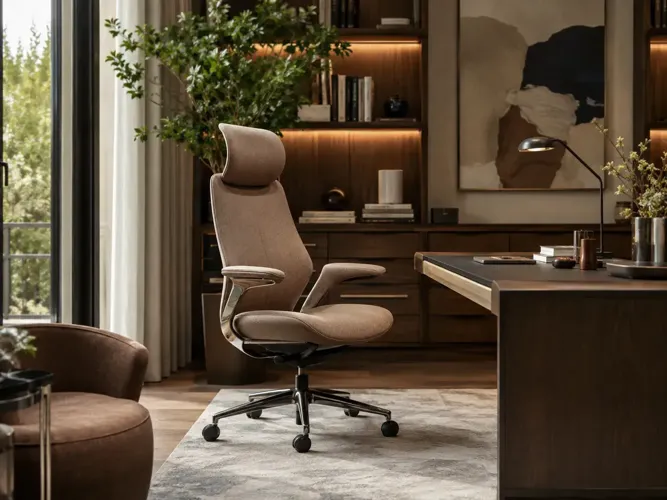

For decades, the office chair operated under a peculiar design exemption. A homeowner could agonize over walnut cabinetry, hand-knotted rugs, sculptural lighting, and the exact shade of plaster on the walls, then roll an enormous black task chair into the middle of it all and simply accept the visual surrender.
That arrangement made more sense when a home office was an occasional room. It makes considerably less sense now.
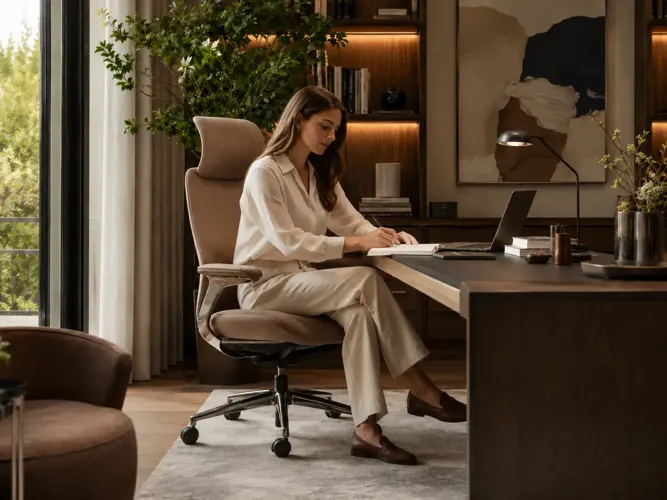
As working from home has become embedded in everyday life, the office chair is being asked to behave more like furniture. It still has to swivel, support, adjust, and survive long stretches at a desk, but increasingly, it also has to look as though someone deliberately chose it for the room.
The result is a new kind of luxury home office chair — one in which comfort and engineering remain essential, but no longer receive permission to ignore the interior around them.
The Executive Chair Is Losing Its Monopoly
The traditional executive chair was designed to communicate authority. High backs, thick padding, substantial armrests, dark leather, and considerable physical presence were part of the formula.
Inside a residential office, however, all that authority can become architectural bullying.
Today's more interesting alternatives rely on proportion rather than bulk. Lower-profile backs, quieter bases, tailored upholstery, sculpted shells, refined metalwork, and wood details allow an office chair to occupy visual space without consuming it.
The distinction matters particularly in offices that open onto a bedroom, library, living area, or hallway. When the chair is visible even when no one is working, it becomes part of the home's furniture collection rather than equipment that disappears at five o'clock.
That is where a designer office chair earns the description. The design is not simply attached to the function. It shapes how the function is expressed.
Ergonomics Should Not Require an Industrial Aesthetic
Removing the corporate look does not mean removing the features that made proper task chairs useful in the first place.
According to OSHA's computer workstation guidance, appropriate seating should provide adequate back and lumbar support, allow the user's feet to be supported, and offer sufficient adjustability for the chair to work with the person and the workstation.
Those principles matter whether the chair is upholstered in black mesh or camel-colored leather.
The design challenge is integrating them discreetly. Lumbar support can be incorporated into the shape of the back. Adjustment controls can remain largely beneath the seat. A swivel base can be slim rather than imposing. Seat construction can provide support without looking overstuffed.
A successful stylish ergonomic chair does not pretend ergonomics are unnecessary. It simply stops treating them as a visual theme.
The Back of the Chair Matters Too

Most furniture is chosen primarily from the angle in which it will be used. An office chair is different because the side facing the room is often its back.
Walk past a home office doorway and that may be the first thing you see.
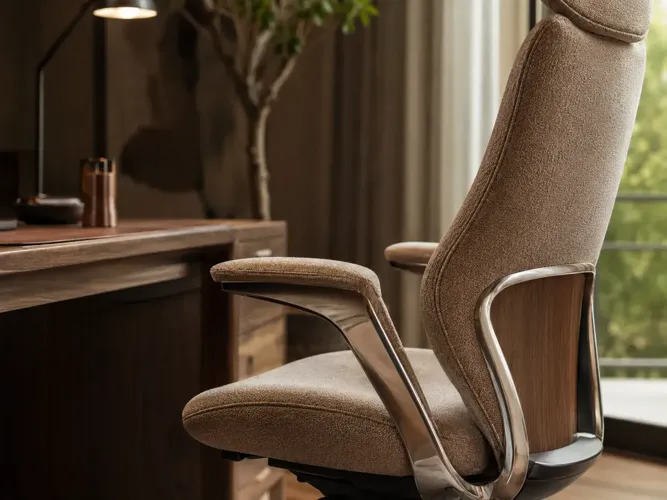
This makes silhouette unusually important. The shape of the backrest, the finish of the frame, the base, the seams, and even the way the upholstery wraps around the chair can influence whether it feels elegant or utilitarian.
Scale matters just as much. A substantial chair may be perfectly at home behind a large architectural desk in a dedicated study. The same chair can overwhelm a smaller workspace tucked into a guest room.
The goal is not to make the chair disappear. It is to make its presence make sense.
FINE's guide to designer lighting and interior layout makes a related point: rooms become more resolved when furniture placement, rugs, lighting, storage, and materials are considered together. An office deserves the same discipline.
Materials Are Moving Closer to Residential Furniture
One reason office seating historically felt so separate from the rest of the home was its limited material vocabulary. Plastic, polished aluminum, mesh, vinyl, and black leather announced the chair's workplace origins immediately.
A more residential approach opens considerably more possibilities.
Full-grain or quality leather can age rather than merely wear. Woven performance fabrics can provide a softer visual presence while still tolerating frequent use. Wood can relate a chair to cabinetry or the desk itself. Brushed metal tends to read more quietly than highly reflective chrome, while warmer neutral upholstery can sit comfortably beside stone, wool, plaster, or natural timber.
Bouclé and heavily textured fabrics can be visually tempting, particularly in a softly furnished room, but this is where restraint is useful. A desk chair experiences constant friction from clothing, hands, and movement. The material has to survive the workday, not just the photograph.
Luxury becomes less convincing when the chair looks exhausted before the person sitting in it does.
The Beautiful-Chair Trap
There is another extreme worth avoiding.
Once homeowners decide that conventional office chairs are unattractive, it is tempting to substitute an upholstered dining chair, accent chair, or sculptural occasional chair behind the desk.
For a writing desk used to answer a few emails, that may be entirely reasonable. For someone working there for hours, appearances alone become a poor selection method.
Fixed seat height, arms that prevent the chair from approaching the desk, inadequate back support, excessive seat depth, or a rigid upright position can turn a beautiful setup into an uncomfortable one.
This is where purpose should determine the compromise.
A home office used occasionally has considerable design freedom. A room used for a full working day needs genuine task seating, even if the mechanism has been wrapped in something considerably more attractive.
A Chair Can Set the Tone of the Entire Office
The chair may also be one of the easiest ways to give a home office personality.
Consider the difference between cognac leather paired with walnut, pale wool upholstery against deep green millwork, a restrained cream chair beside a stone desk, or a slim dark silhouette inside an otherwise light room. Each establishes a different mood before art, books, or accessories enter the conversation.
This is one reason there is no convincing single formula for the luxury home office.
A financial executive's study does not need to resemble an architect's workspace. A writer may want softness and bookshelves. A designer may favor a highly sculptural environment. Someone with a view may deliberately select a low-backed chair to avoid interrupting it.
The most successful rooms look personal because they solve for the person occupying them rather than for an abstract idea of what an office should resemble.
For readers reconsidering the entire workspace, FINE's Building a Home Office That Feels as Good as It Works looks more broadly at creating a room for everyday work.
What Makes a Luxury Home Office Chair Worth ItPric0e alone does not transform office furniture into luxury furniture.

The stronger measure is whether the chair brings together attributes that are difficult to fake: thoughtful proportions, dependable mechanisms, quality upholstery, supportive construction, useful adjustability, good movement, repairability where possible, and materials that still look appropriate after years rather than months.
It should also have enough visual restraint to survive changes around it. Rugs get replaced. Walls are repainted. Desks move. Rooms evolve.
A truly well-chosen office chair should not require the entire room to remain frozen around it.
That may be the clearest indication of how far the home office has come. The chair at the center of the room no longer has to be tolerated because it performs an important job.
It can finally perform that job and still deserve to be seen.

(0) comments
We welcome your comments
Log In
Post a comment as Guest
Keep it Clean. Please avoid obscene, vulgar, lewd, racist or sexually-oriented language.
PLEASE TURN OFF YOUR CAPS LOCK.
Don't Threaten. Threats of harming another person will not be tolerated.
Be Truthful. Don't knowingly lie about anyone or anything.
Be Nice. No racism, sexism or any sort of -ism that is degrading to another person.
Be Proactive. Use the 'Report' link on each comment to let us know of abusive posts.
Share with Us. We'd love to hear eyewitness accounts, the history behind an article.