
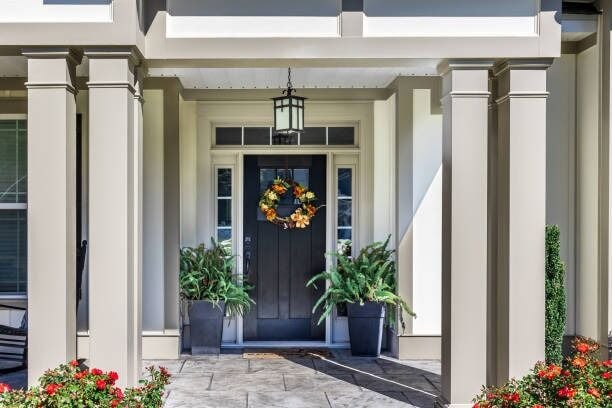
Your front entrance isn't just a door with some plants beside it. It's one composition, and every element in it either works with the others or quietly fights against them.
The greenery you pick affects how the door reads. The door finish affects how the plants look against it. The way the afternoon sun hits that whole arrangement determines whether both hold up over the years or start looking rough after one season.
This article focuses properly on outdoor plants, on doors, and finally on how to make them work together as one.
Why Outdoor Plants Fail, And It's Usually Not the Buyer's Fault
The frustrating thing about this topic is that negative experiences with outdoor artificial plants are almost always the result of misleading product labeling.
Someone walks into a garden center or browses online, finds a plant described as "suitable for outdoor use," pays decent money for it, installs it at their entrance, and within a single summer, it's bleached, brittle, and curling at the edges.
This is not a case of the product failing to meet unrealistic expectations. That's a product that was never properly built for outdoor conditions, being sold as if it were.
Quality construction addresses these issues through material density and internal wire reinforcement that holds the structure even when the outer plastic is warm from the sun.
For entrance-scale placements, tall flanking pieces, courtyard features, and statement garden trees, the difference between generic and properly made artificial outdoor trees is genuinely visible.
Where You Place Them Changes Everything
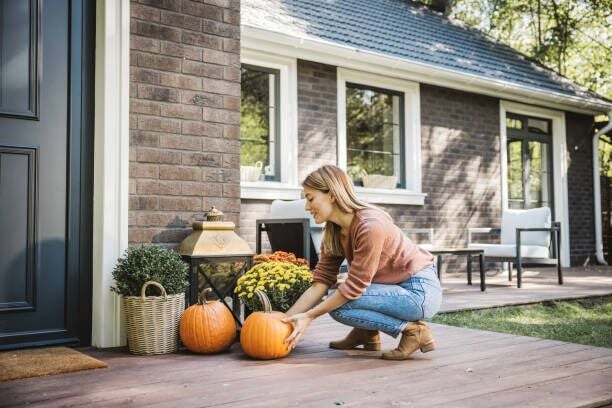
Plants in those positions need the full specification: compounded UV stabilization, heat-tolerant material, and solid structural construction.
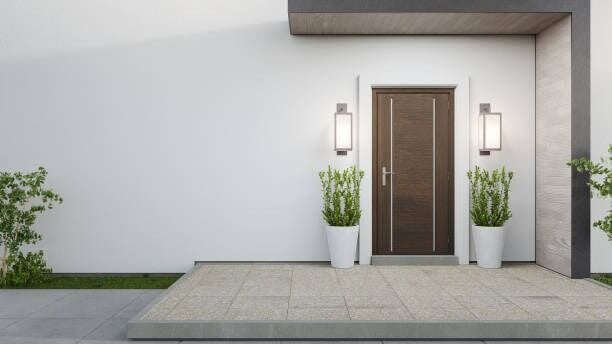
Greenery on either side anchors it. The entrance reads as a considered focal point rather than just a gap in the wall.
When Standard Sizes Don't Cut It
Off-the-shelf sizing works for most standard residential entrances and doesn't work for double-height residential entrances. Commercial lobby installations where ceiling clearance and fire regulations both apply. Rooftop terraces with unusual wind loads.
Hotel exteriors where the scale of the planting needs to match architecture that's simply larger than anything in a standard catalog. In those situations, a custom artificial plants manufacturer gives you something that ready-made products can't: plants built to the actual dimensions of the space, with UV and structural specifications chosen for the actual conditions of the site.
The alternative is buying the largest available standard product and watching it look undersized once installed. That happens more often than manufacturers of standard products would like to admit.
Custom doesn't automatically mean expensive beyond reason. For projects where scale genuinely matters to the result, it's often the more cost-effective choice when you factor in the alternative of buying multiple standard pieces that still don't look right.
Choosing a Door That Suits an Exposed Exterior
The door receives the most attention in any entrance, which means it also carries the highest risk if you make the wrong choice.
Style is the obvious starting point. A flush contemporary door on a traditional stone-built property looks like a mistake someone made and didn't fix. A heavy ornate panel door on a sleek modern facade looks equally wrong in the other direction.
But construction quality is what determines whether a door keeps looking good or starts causing problems. In exposed positions with significant sun and rain variation across seasons, that maintenance burden is real.
A specialist door manufacturing company builds to specific requirements, including dimensions, materials, finishes, and hardware, rather than offering fixed options from a catalog. For entrances where the door is genuinely a feature of the property rather than a functional necessity, that matters.
Making the Door and Plants Work as One
Lighter door finishes, pale grey, off-white, and natural timber tones suit artificial plants with more tonal variation in the leaves. Variegated greens, mixed foliage textures, and plants that lighten the upper leaves and deepen lower down.
A large, heavy door with a strong architectural presence can carry substantial flanking trees without the entrance feeling cluttered. A standard residential door in a modest frame gets overwhelmed by oversized statement pieces; neater, more contained greenery suits it better.
Pots and planters are the detail most people underestimate. Matching planter finish to door hardware, brushed steel against brushed steel handles or matte black against black ironmongery, is a simple decision that creates coherence across the whole entrance composition.
What Maintenance Actually Looks Like for Both
A rinse with plain water two or three times a year keeps leaf surfaces clean. Dust and airborne grime accumulate gradually and make plants look dull long before any UV or heat damage sets in.
Cleaning addresses that easily :
No watering
No replanting
No seasonal storage
No pest management.
For entrance positions where regular gardening maintenance is physically awkward, that's not a small advantage.
Together, a well-chosen door and properly made outdoor plants create an entrance that holds its appearance across seasons and years without demanding constant effort.
The entrance to a home or commercial property sets an expectation for everything behind it. Get proper outdoor-grade plants in the right positions and a door suited to the architecture and built to last in real conditions, and the result rewards you for years with almost nothing required in return.
Cheap artificial plants that fade by summer's end, a door chosen for looks without regard for material performance, and you're back making decisions you thought you'd already made. The choices themselves aren't complicated.
Frequently Asked Questions
What door material works best for a south-facing entrance with sun exposure?
Both resist warping, fading, and heat expansion better than solid timber. Aluminum frames should be thermally broken.
Is custom sizing for artificial plants worth the additional cost?
For standard residential entrances, ready-made sizing usually covers what's needed. For larger properties, commercial spaces, double-height entrances, or anywhere standard products consistently look undersized once installed, custom is worth it.
Can artificial outdoor trees handle strong winds alongside sun and heat?
Larger feature pieces designed for exposed positions have heavier base systems and thicker stem construction.
(0) comments
We welcome your comments
Log In
Post a comment as Guest
Keep it Clean. Please avoid obscene, vulgar, lewd, racist or sexually-oriented language.
PLEASE TURN OFF YOUR CAPS LOCK.
Don't Threaten. Threats of harming another person will not be tolerated.
Be Truthful. Don't knowingly lie about anyone or anything.
Be Nice. No racism, sexism or any sort of -ism that is degrading to another person.
Be Proactive. Use the 'Report' link on each comment to let us know of abusive posts.
Share with Us. We'd love to hear eyewitness accounts, the history behind an article.