


Late summer has its own rhythm. The evenings are still warm, the markets are overflowing with stone fruit, and dinner somehow tastes better when it happens outdoors.
It is also the perfect moment to rethink what a dinner from the grill can look like. Forget the predictable parade of burgers and steaks. Peaches can become smoky and deeply caramelized. Watermelon can develop a savory side. Halloumi can take on a golden crust. Even dessert can come directly off the fire.
For Stephanie Banyas, Culinary Experience Manager at Kalamazoo Outdoor Gourmet, great outdoor cooking comes down to understanding what heat, smoke and different fuels actually do to food — then building a menu that lets those elements shine without overwhelming everything else.
Fruit May Be the Most Underrated Ingredient on the Grill

Putting a ripe peach over an open flame changes far more than its temperature. According to Banyas, three things happen when fruit meets direct heat: its natural sugars caramelize, moisture evaporates and concentrates the flavor, and the fire introduces a subtle layer of smokiness.
Dense, naturally sweet fruits are particularly rewarding. Pineapple, peaches, nectarines, bananas and even watermelon can all develop a more complex flavor once grilled.
There is another trick that may save the fruit bowl: grilling can improve underripe fruit. Produce that is not quite spectacular enough to serve raw can gain sweetness, softness and character from heat.
Watermelon is perhaps the bigger surprise.
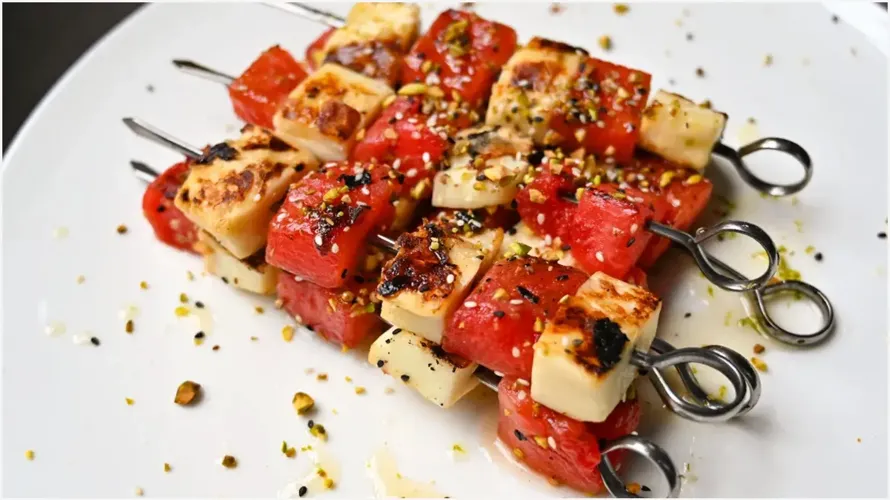
Banyas recommends searing it quickly over intense heat, around 450 to 500 degrees Fahrenheit. That short blast creates caramelization on the outside while preserving the texture within. Low heat does the opposite, allowing the melon to steam until it becomes soft and watery.
Her Grilled Halloumi & Watermelon Skewers with Lime Basil Dressing and Pistachio Dukkah put that technique to work, pairing the smoky sweetness of grilled watermelon with salty cheese.
Halloumi also benefits from speed. Banyas suggests cutting it about a half-inch thick, drying the surface well, brushing it lightly with oil and grilling it for roughly two minutes per side over high heat. The goal is a crisp exterior with a softened center, not a piece of cheese that has spent enough time over the fire to become rubbery.
High Heat Is the Secret Many Home Cooks Avoid
One of the biggest differences Banyas sees between professional and home cooks is their relationship with heat.
“Char doesn’t mean burnt, it means flavor,” she says.
A properly heated grill encourages browning and the Maillard reaction that creates complex savory flavors in meats, seafood and vegetables. If the grill or grates are not hot enough, food can begin steaming instead of charring.
Temperature, however, is not a contest to see how high the dial will go. Grilled fruit needs enough heat to caramelize without scorching before the center warms. Delicate ingredients require particularly close attention.
Banyas also points to seasoning, oiling and resting as fundamentals that can dramatically change the finished dish. She prefers salting proteins well in advance when possible, while a light coating of oil can help delicate fish and vegetables release cleanly from the grill.
For meats, a food thermometer remains important. Safe minimum internal temperatures vary depending on the protein, so outdoor cooks should follow current USDA food-safety guidance rather than relying solely on color or cooking time.
Gas, Charcoal and Wood Do Not Taste the Same

The fuel beneath the grates is not simply a matter of convenience.
Gas offers speed and precise temperature control, making it useful when the cook wants consistency without waiting for charcoal or managing a wood fire. Charcoal and wood, however, bring another layer to the meal.
Banyas reaches for charcoal with steaks, burgers, sausages and vegetables such as zucchini, asparagus, mushrooms, eggplant and sweet potatoes. For poultry, lobster, pork and ribs, she often looks to wood smoke.
But more smoke is not necessarily better.
Different woods have different personalities. A powerful wood such as mesquite or hickory can overpower something delicate like lobster, while lighter woods such as apple or maple may disappear against the richness of beef ribs.

That ability to choose the fire according to the food is part of what Banyas enjoys about Kalamazoo's Hybrid Fire Grill, which allows cooking with gas, charcoal or wood. It also reflects a larger change happening outside the kitchen walls. As FINE recently explored in Why Luxury Homes Are Turning Backyards Into Wellness Sanctuaries, elaborate outdoor kitchens are increasingly becoming true living and entertaining spaces rather than a lonely grill parked beside a patio table.
The Host Should Not Spend Dinner Trapped at the Grill
A beautiful outdoor kitchen loses some of its charm if the person who invited everyone over disappears behind a cloud of smoke for three hours.
Banyas recommends borrowing a habit from professional kitchens: do the majority of the work before guests arrive.
Choose appetizers and side dishes that can be made ahead and served cold or at room temperature. Grilled-bread bruschetta, panzanella, potato salad, vegetable antipasto and Mexican street corn salad all fit the strategy.
Then save the theater for dishes that genuinely benefit from being cooked to order.
A shrimp skewer might require only a few minutes. Steaks can become part of the evening rather than an interruption to it. Sauces, vinaigrettes and accompaniments can already be waiting.
And there is no reason the guests cannot drift toward the grill. Outdoor cooking works particularly well as entertainment because people naturally gather around the fire.
One Ingredient Can Work Harder Than You Think
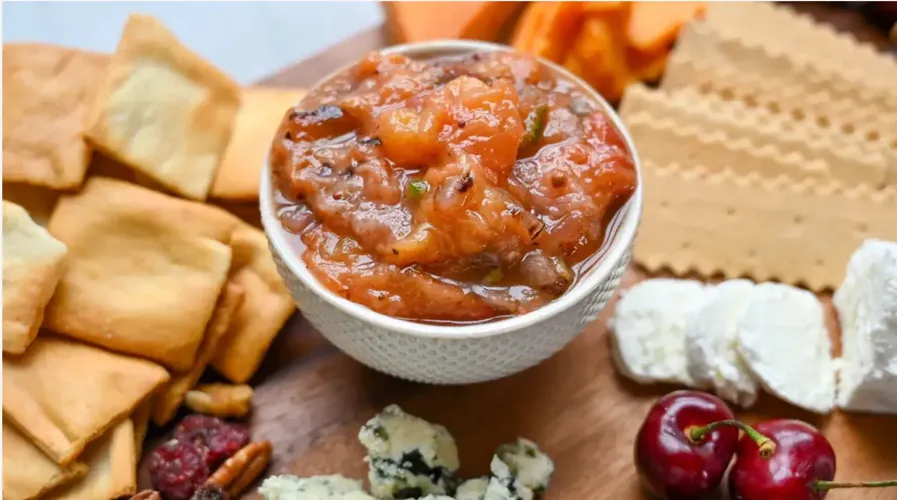
Banyas's Grilled Spicy Peach-Ginger Chutney demonstrates another smart entertaining principle: make one excellent component and find subtle ways to use it throughout the menu.
A seasonal chutney might appear with a cheese board, then be blended with grainy mustard as a dipping sauce. A spoonful can be whisked into vinaigrette or folded into barbecue sauce.
For pork, Banyas likes blending some of the peach chutney with Dijon mustard to create a glaze, brushing it onto the meat toward the end of grilling while serving additional chutney alongside.
The trick is repetition without making the repetition obvious.
Summer tomatoes, cherries and stone fruits can fill that role now; cranberries, figs, pears and apples can take over when autumn arrives.
Smoke Should Be an Accent, Not the Entire Menu
Perhaps the easiest mistake with an outdoor dinner is deciding that because there is a beautiful grill, absolutely everything must taste intensely grilled.
Banyas takes a lighter approach.
Grill bread for a panzanella and allow ripe tomatoes and crisp vegetables to remain the stars. Char whole sweet potatoes until their interiors become almost custard-like, then finish them with herb butter, honey or orange zest. Let the main course carry deeper wood or charcoal flavor.
Dessert can return to subtlety.
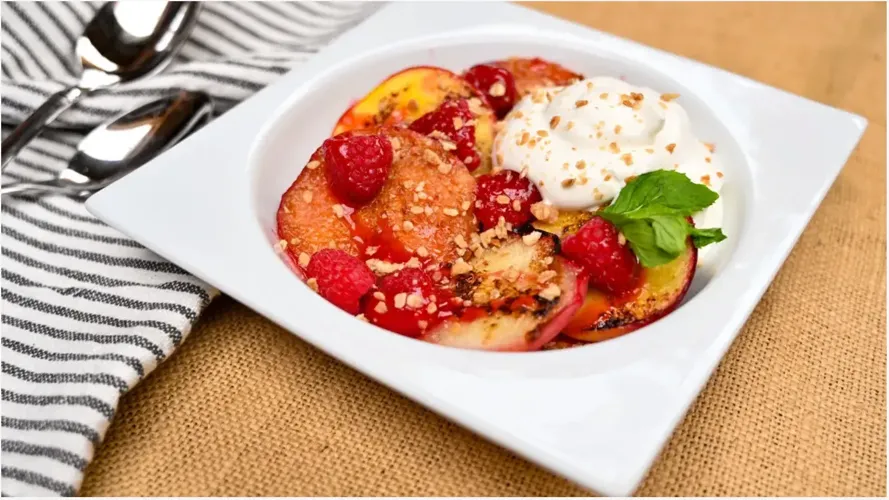
Her Grilled Nectarine Melba with Vanilla Bean Mascarpone Creme makes use of caramelized stone fruit without ending dinner on a heavy note. The nectarines can also move beyond dessert entirely. Banyas suggests serving grilled fruit with vanilla-scented Greek yogurt and orange zest for an outdoor breakfast or brunch.
Smoking may be the technique she expects more sophisticated home cooks to embrace next. While hardly new, she believes backyard cooks are becoming increasingly curious about different woods, smoking methods and the nuances of flavor they can create.
A Late-Summer Dinner Worth Remembering
Ask Banyas which of these combinations is most likely to surprise people and she comes back to watermelon and halloumi.
Most home cooks do not think of grilling either ingredient, much less putting them together.
That may be the larger lesson of the late-summer table.
Outdoor entertaining becomes much more interesting once the grill stops being viewed as a machine exclusively designed for meat. It can caramelize fruit, transform vegetables, toast bread, roast an entire meal and turn a familiar ingredient into something guests have never quite tasted that way before.
The best late-summer dinner does not need to be complicated. It needs a few seasonal ingredients, thoughtful preparation, the right fire and enough restraint to know when to leave something alone.
And ideally, a host who actually gets to sit down and eat.


(0) comments
We welcome your comments
Log In
Post a comment as Guest
Keep it Clean. Please avoid obscene, vulgar, lewd, racist or sexually-oriented language.
PLEASE TURN OFF YOUR CAPS LOCK.
Don't Threaten. Threats of harming another person will not be tolerated.
Be Truthful. Don't knowingly lie about anyone or anything.
Be Nice. No racism, sexism or any sort of -ism that is degrading to another person.
Be Proactive. Use the 'Report' link on each comment to let us know of abusive posts.
Share with Us. We'd love to hear eyewitness accounts, the history behind an article.